

Log every expense straight away
The golden rule: an expense is logged the moment it’s paid. For each one, you need three pieces of information:
- the amount;
- who paid;
- who it’s for (the whole group, or only some people).
The “who it’s for” part is essential. If two people aren’t coming on the boat trip, they shouldn’t have to pay for it.
Work out everyone’s balance
For each person, you take the difference between what they paid and what they used. An example with three friends:
- Léa paid for the apartment: €300 for the three of them.
- Sam paid for a dinner: €90 for the three of them.
- Inès hasn’t paid for anything.
Total: €390, so €130 each. Léa paid €300 for a share of €130, so she gets €170 back. Sam paid €90, so he’s €40 short. Inès owes €130.
Pay back with as few transfers as possible
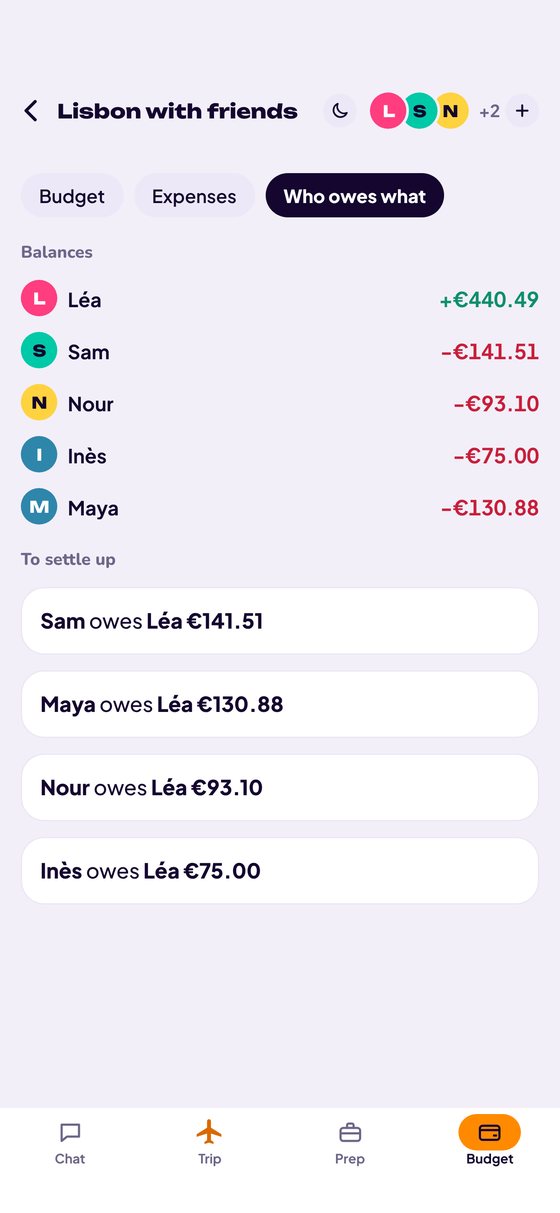
There’s no need for everyone to pay everyone back. Here, two transfers are enough: Inès sends €130 to Léa and Sam sends €40 to Léa. Everyone’s even. With ten people and fifty expenses, this calculation quickly becomes a pain by hand, and that’s where an app saves you time.
The classic traps
- Forgotten small expenses: a coffee, a metro ticket. They add up fast.
- Partial expenses: the person who doesn’t drink alcohol shouldn’t pay for the cocktails.
- Repayments made but not logged: a transfer that’s been sent has to be recorded, otherwise the balance stays wrong.
- Waiting until the end of the trip: the longer you wait, the more you forget.
What about a shared kitty?
Everyone putting the same amount into a pot works well for groceries and small everyday spending. For the big items (accommodation, transport), it’s simpler for one person to pay upfront and the others to pay back their share.